Funny Replies to “Skibidi” or Random Gen‑Alpha Slang – 60+ Witty Comebacks
🎯 The single best response when a kid hits you with “skibidi” or any brain‑melting Gen‑Alpha word: “I think my phone autocorrected that to ‘go clean your room.’ Weird how that works.” (Delivered with a slow, confused blink – you’ve just out‑awkwarded their awkward.)
You’re minding your own business. Then a small human looks you dead in the eye and says: “Skibidi.” Or “rizz.” Or “gyatt.” Or “fanum tax.” Your brain buffers. You feel approximately 100 years old. Welcome to the world of Gen‑Alpha slang – a linguistic fever dream that sounds like someone dropped a bag of Scrabble tiles on a keyboard.
But here’s the secret: you don’t need to understand it to reply to it. In fact, not understanding is your superpower. The best funny replies to “skibidi” or random gen‑alpha slang embrace the confusion, flip the script, and make the kid laugh at you – in a good way. This guide gives you 60+ playful, self‑deprecating, and gently roasting comebacks for any nonsense word they throw at you. Plus a handy decoder for the most common terms (so you can at least pretend to know what’s happening).
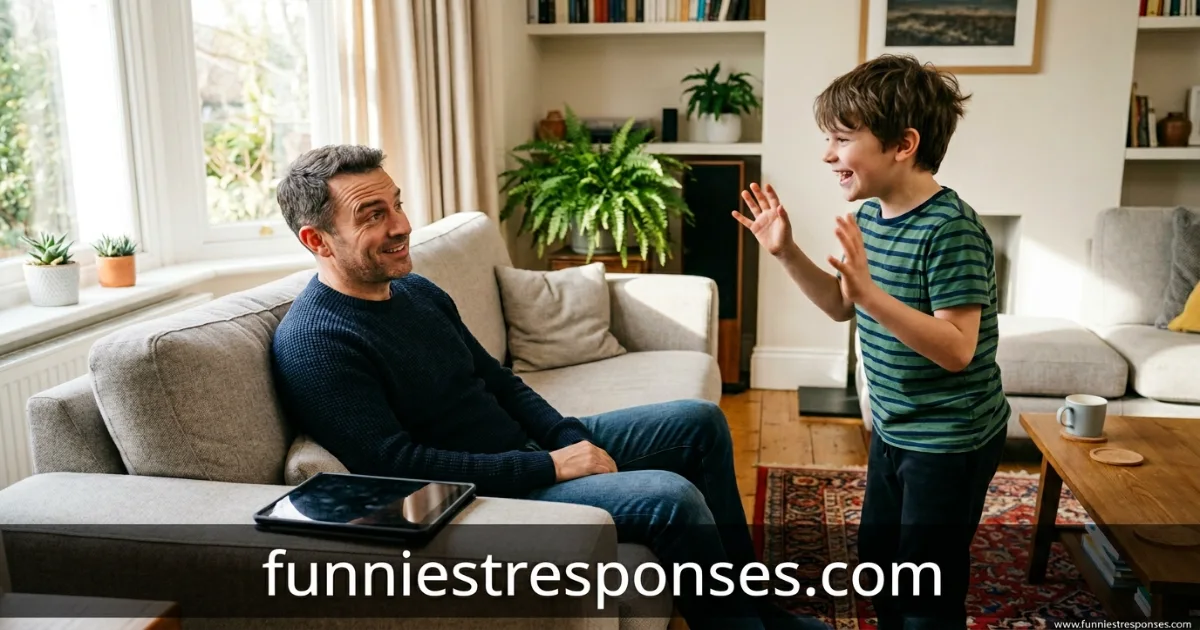
Why Gen‑Alpha Slang Feels Like an Alien Language (And Why That’s Funny)
Every generation creates its own code. Millennials had “cringe” and “lit.” Gen Z gave us “no cap” and “bet.” But Gen‑Alpha? They’ve taken it to another dimension – words that seem to have no meaning (“skibidi”), words stolen from other contexts (“rizz” from charisma), and inside jokes that move faster than TikTok trends. The key insight: kids don’t expect you to understand. In fact, they’re kind of hoping you don’t. Your floundering is entertainment. So instead of pretending to be cool, lean into the confusion with a witty reply that makes everyone laugh.
First, A Quick Decoder (So You’re Not Completely Lost)
Before the comebacks, here’s a cheat sheet for the most common Gen‑Alpha slang. Knowing what they think they’re saying helps you craft funnier responses.
- “Skibidi” – From the “Skibidi Toilet” meme. Often just a nonsense filler word or exclamation.
- “Rizz” – Charisma / charm. “He’s got rizz” = he’s smooth.
- “Gyatt” – Exclamation of surprise/excitement, originally from “gyatt damn.”
- “Fanum tax” – When someone steals a bit of your food. From YouTuber Fanum.
- “No cap” – No lie / for real.
- “Bet” – Okay / agreed.
- “Yeet” – To throw with force, or an exclamation of excitement.
- “Mewing” – A tongue posture trend; kids joke about it constantly.
Now, armed with this intel, let’s get to the good stuff.
60+ Funny Replies (Organized by Vibe)
From deadpan confusion to full absurdity – pick your weapon.
🤷♂️ Confused & Self‑Deprecating (For when you own your cluelessness)
- “I think my brain just left the chat. Send help.”
- “I’m too old to understand that, but I’m young enough to pretend I do. Skibidi… yourself?”
- “Did you just sneeze? Bless you.”
- “I had a stroke reading that sentence. But I’m fine. Mostly.”
- “My dictionary said ‘word not found.’ Then it crashed.”
😏 Playful & Deflective (Turning the tables)
- “Oh yeah? Well… bibbidi‑bobbidi‑boo. Take that.”
- “I’d respond, but I only speak English, sarcasm, and Thanksgiving dinner small talk.”
- “That’s nice, honey. Now go ask your mom if ‘skibidi’ is a vegetable.”
- “I’ll trade you: one ‘skibidi’ for one ‘back in my day.’”
- “Sorry, I don’t speak Morse code. Try semaphore.”
😂 Exaggerated Confusion (For maximum physical comedy)
- Tilt head like a confused dog. “I’m sorry, I don’t speak microwave.”
- “Did you just call me a toilet? I’m flattered?”
- “I ran that through Google Translate. It said ‘please do your homework.’”
- “Bless you again. That sounded contagious.”
- “I’m having a ‘skibidi’ right now. It’s when an adult’s soul leaves their body.”
😎 Gently Roasting (For close kids who can take a joke)
- “Your generation invented ‘skibidi’ and mine invented ‘saving for retirement.’ Let’s call it even.”
- “I’d explain why that’s not a real word, but I see you’re still eating glue. Priorities.”
- “That’s cute. Now watch this: ‘Please pass the remote.’ That’s adult slang.”
- “I’ll give you a dollar for every real word you say. Starting now. Oh wait, zero.”
- “Skibidi this, skibidi that – have you tried ‘skibid-ing’ your homework?”
🧠 Clever & Educational (Turning it into a lesson)
- “Interesting. Is that from the Latin root ‘skib’ meaning ‘to confuse elders’?”
- “You know, the dictionary adds new words every year. I’ll wait for that one.”
- “I don’t know what that means, but I love that you’re creative with language. Now say it in a full sentence.”
- “If you can use ‘skibidi’ in a grammatically correct sentence, I’ll give you five dollars.” (Safe bet.)
Which Reply Fits the Situation?
| Kid’s age / vibe | Best category | Example line |
|---|---|---|
| Under 8 (just being silly) | Exaggerated Confusion | “Did you just call me a potato? I’m honored.” |
| 8–12 (testing boundaries) | Playful & Deflective | “That’s nice. Now go clean your room in ‘skibidi’ speed.” |
| Your own kid (repeat offender) | Gently Roasting | “Skibidi? I’ll skibidi your screen time if you don’t stop.” |
| Student in class | Confused & Self‑deprecating | “I think my ears just glitched. Try English?” |
How to Deliver These Replies (Tone & Body Language = 70% of the Win)
🎤 Kids smell fear. Use these 5 steps to land your comeback perfectly:
- Pause and tilt your head slightly – like a dog hearing a strange noise. This buys you time and looks funny.
- Blink slowly twice – the universal sign of “my brain is buffering.”
- Say your line with a light, amused voice – don’t sound angry or sarcastic (kids miss sarcasm).
- Add a physical gesture: pat your pockets, look under the couch, or check your watch.
- Then immediately ask them a question – “Anyway, what’s for lunch?” or “Does that word come with a dance move?”
Pro tip: If you completely blank, just say “I’m having a moment. Let me reboot.” Then pretend to press an invisible button on your forehead. Kids lose it.
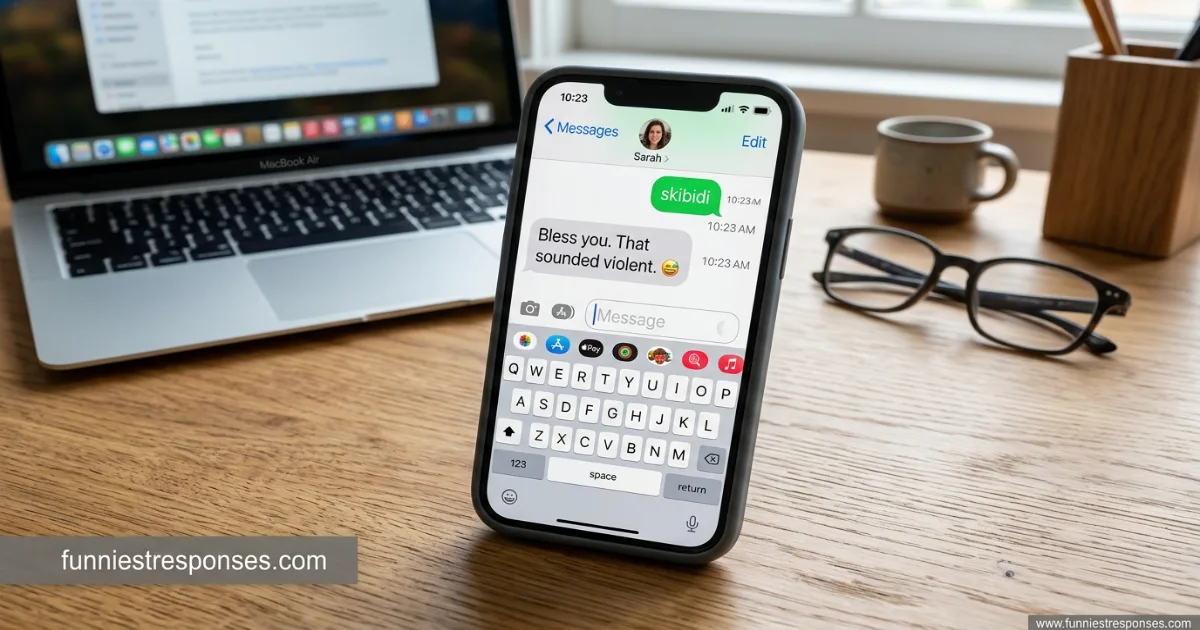
Texting vs. In‑Person: What Changes
When a kid texts you a random “skibidi” or a string of Gen‑Alpha nonsense, you can’t rely on your confused face. So adapt:
- Use emojis to signal tone: “I think my phone had a seizure 🤷” or “Bless you 😅”
- Keep it short. “Translation? I only speak adult emojis 💼☕” works great.
- Send a voice note. A 3‑second audio of you saying “I don’t know what that means but I support you” is pure gold.
- If they keep going, double down on absurdity: “My response is ‘flibbertigibbet.’ Take that.”
Remember: texting slang is how they bond with friends. By replying with warmth and humor, you’re signaling that you’re a safe person to be silly with.
What NOT to Say (Mistakes That Make You the Enemy)
Even tired adults mess this up. Avoid these common blunders:
- ❌ “That’s not a real word. Speak properly.” – Boom. You’re now the boring adult they’ll never joke with again.
- ❌ Trying too hard to use the slang correctly. “Oh, you have rizz? I have rizz too!” – Cringe. Just don’t.
- ❌ “I don’t care about your nonsense.” – Harsh and dismissive. Kills connection.
- ❌ A long lecture about the decline of language. – They’re 9. They don’t care.
- ❌ Ignoring them completely. – Feels like rejection. Even a silly “what?” is better than silence.
The golden rule: never shame the kid for using slang. It’s their cultural currency. Your job is to play along or deflect with humor, not to correct.
Real‑World Scenarios (From the Trenches)
Scenario 1 (nephew, age 10, at dinner): “Uncle, you have no rizz.” You: “No rizz? I’ll have you know I once convinced a waiter to give me extra breadsticks. That’s peak rizz.” He laughs. Dinner saved.
Scenario 2 (your daughter, age 9, in the car): “Dad, skibidi!” You: “Is that a new rapper? Sounds like a dance move. Show me.” She laughs and tries to invent one. Bonding achieved.
Scenario 3 (student, age 11, in class): “Ms. Johnson, gyatt!” You, without missing a beat: “Bless you. Now open your math book to page 42.” Class giggles, but you’ve kept control.
When NOT to Use a Funny Reply (Important)
Humor is great, but not every moment needs it. Avoid jokes if:
- The kid is trying to tell you something serious (e.g., “I’m being bullied” disguised as slang). Then say “Wait, can you say that again in plain English? I want to understand.”
- You’re in a formal setting like a classroom where the teacher expects respectful language. A simple “Let’s use full sentences, please” is fine.
- The child is already upset or angry – humor can feel dismissive. Just listen first.
- You’ve already made three jokes in a row – give the kid a turn to speak normally.
When in doubt, a warm “I don’t know what that means, but I’m glad you’re talking to me” works every time.

Related Reading on FunniestResponses
FAQs: Everything You’ve Wondered About Gen‑Alpha Slang Comebacks
What’s the best reply to “skibidi” specifically?
“Bless you. That sounded violent.” or “Is that the new dance? Show me.” Both acknowledge the absurdity without pretending to understand.
Can I use these replies on my students without losing respect?
Yes, if you keep it brief and light. “I’m too old for this – but I like your energy. Now back to fractions.” It shows you’re human but still in charge.
What if the kid gets offended by my joke?
Rare, but if it happens, say “I was just playing. I actually think it’s cool you have your own language.” Then change the subject. Kids forgive fast.
How do I reply if I actually want to learn the slang?
Say “Teach me. What does ‘skibidi’ mean? Use it in a sentence.” Kids love being the expert. You’ll bond and maybe even learn something.
Is it okay to use Gen‑Alpha slang back at them?
Rarely. Only if you do it ironically and badly. “I’m feeling very ‘skibidi’ about this pizza.” They’ll cringe-laugh. Overusing it makes you look desperate.
What’s a good reply when they won’t stop saying the same word?
“New rule: every time you say ‘skibidi,’ you owe me one chore. You’re at three skibidis – that’s one trash takeout.” Turns annoyance into a game.
Do these work for tweens (11–13) too?
Yes, but they prefer drier, more sarcastic replies. Try “Fascinating. Tell me more when you learn real words.” delivered with a deadpan face.
📌 Your Cheat Sheet – Top 3 Replies to Gen‑Alpha Slang (Memorize These)
- 🏆 Best all‑rounder (confused & funny): “I think my brain just left the chat. Send help.”
- 😂 Best for quick laughs (exaggerated): “Did you just sneeze? Bless you.”
- 😏 Best for close kids (gentle roast): “That’s cute. Now watch this: ‘Please pass the remote.’ That’s adult slang.”
Practice your confused face in the mirror once. Then go forth and confuse a child with your wit.