Witty Comebacks for “You’re Too Sensitive” – 25 Smart Replies
🎯 Quick Answer — the #1 comeback that shuts down the gaslighting gently:
“I’m not too sensitive. You’re just not sensitive enough.”
(Delivered with a calm smile. It flips the script without aggression.)
You express a feeling. You set a boundary. You react to a joke that stung. And then they hit you with the classic dismissal: “You’re too sensitive.” Ugh. That phrase is the Swiss Army knife of invalidation — used by friends, family, coworkers, and even partners to avoid taking responsibility. It makes you question yourself: Am I overreacting? Should I just laugh it off?
No. You’re not broken. Your feelings are data, not defects. But instead of getting into a debate about emotional intelligence (exhausting), you can deploy a witty comeback for “you’re too sensitive” that lands with humor and poise. The right reply protects your dignity, exposes their dismissal, and often makes them pause — without you looking like the bad guy. This article gives you 25 clever, non-offensive responses for every relationship, plus delivery psychology, texting versions, and when to walk away instead.
Friends, family, dates, toxic bosses, group chats.
Someone is genuinely apologizing or the setting is ultra-formal.
Medium – requires steady tone and no defensiveness.
Assert your reality without escalating.

Why “You’re Too Sensitive” Is Such a Tricky Phrase
Psychologists call it a “gaslighting lite” tactic. The speaker avoids addressing your actual point by attacking your emotional response. It’s a power move: they get to stay comfortable while you scramble to prove you’re not “crazy.” Most people freeze because they feel cornered — either you defend yourself (which “proves” their point) or you shut down (and resent them). The solution is a third path: humorous boundary-setting. A witty comeback acknowledges the jab but doesn’t absorb it. It signals “I hear you, I don’t agree, and I’m not hurt — I’m actually amused by your strategy.” That confidence is disarming. And it keeps you in control.
The Best Witty Comebacks (by Vibe)
I’ve organized 20+ replies into four categories: playful reframes, calm assertions, self-aware jabs, and gentle shutdowns. No cruelty — just cleverness.
😌 Playful Reframes (turns the insult into a joke about them)
- “I’m not too sensitive. You’re just too comfortable being rude.”
- “Sorry my emotional intelligence makes you uncomfortable.”
- “You say sensitive like it’s a bad thing. I call it having a working heart.”
- “I’m not sensitive. I’m just allergic to nonsense.”
🧘 Calm Assertions (direct but not aggressive)
- “I’m reacting appropriately to what you said. That’s not oversensitive — that’s honest.”
- “I’ll take that as ‘I don’t want to examine my own behavior.’”
- “Actually, I’m exactly sensitive enough to know when something’s off.”
- “Calling someone too sensitive is just a way to avoid apologizing.”
😂 Self-Aware Jabs (lightly mocking yourself while exposing them)
- “You’re right, I am sensitive. Sensitive to BS.”
- “I prefer ‘accurately emotional.’ But sure.”
- “And you’re too blunt. Guess we’re both burdened with superpowers.”
- “Let’s agree: I’m sensitive, and you’re dismissive. Now what?”
🛡️ Gentle Shutdowns (ends the conversation with class)
- “I hear you. I still feel what I feel. Let’s move on.”
- “Okay. Noted. Anyway…” (then change the subject)
- “Maybe. But we were talking about what you said. Let’s stay on topic.”
- “I’ll think about that. Meanwhile, please don’t talk to me that way again.”
When someone says “you’re too sensitive,” they expect you to either get defensive or cry. These replies do neither. They agree partially (“yes, I am sensitive to certain things”) then redirect the spotlight back to the speaker’s behavior. That’s called “strategic validation” — you acknowledge the label but redefine it on your terms. Studies show that this kind of calm, witty reframing reduces the other person’s urge to keep dismissing you, because you’ve refused to play the victim role.
| Comeback Type | Best Audience | Example Line | Risk of Escalation |
|---|---|---|---|
| Playful Reframe | Friends, siblings, peers | “Sorry my emotional intelligence makes you uncomfortable.” | Very low – reads as witty |
| Calm Assertion | Partners, close coworkers | “I’m reacting appropriately to what you said.” | Low – if tone is steady |
| Self-Aware Jab | Close friends, comedy-friendly circles | “Sensitive to BS.” | Medium – might offend some |
| Gentle Shutdown | Toxic relatives, bosses, strangers | “Noted. Anyway…” | Near zero – ends the thread |
How to Deliver These Lines (Tone Is Everything)
Delivery checklist for maximum impact
- Stay calm. If you’re shaking, take a breath first. A level voice = power.
- Make eye contact for one beat only. Then look away casually. Intense staring reads as aggression.
- Smile slightly. Not a smirk (that’s mean). A small “I’m fine” smile.
- Then pause. Let the line land. Don’t fill the silence with nervous laughter.
- After 3 seconds, change the subject or walk away. You’ve won.
Practice tip: Say your favorite line to a mirror while holding a cup of tea. If you can sip afterward without spilling, you’re ready.
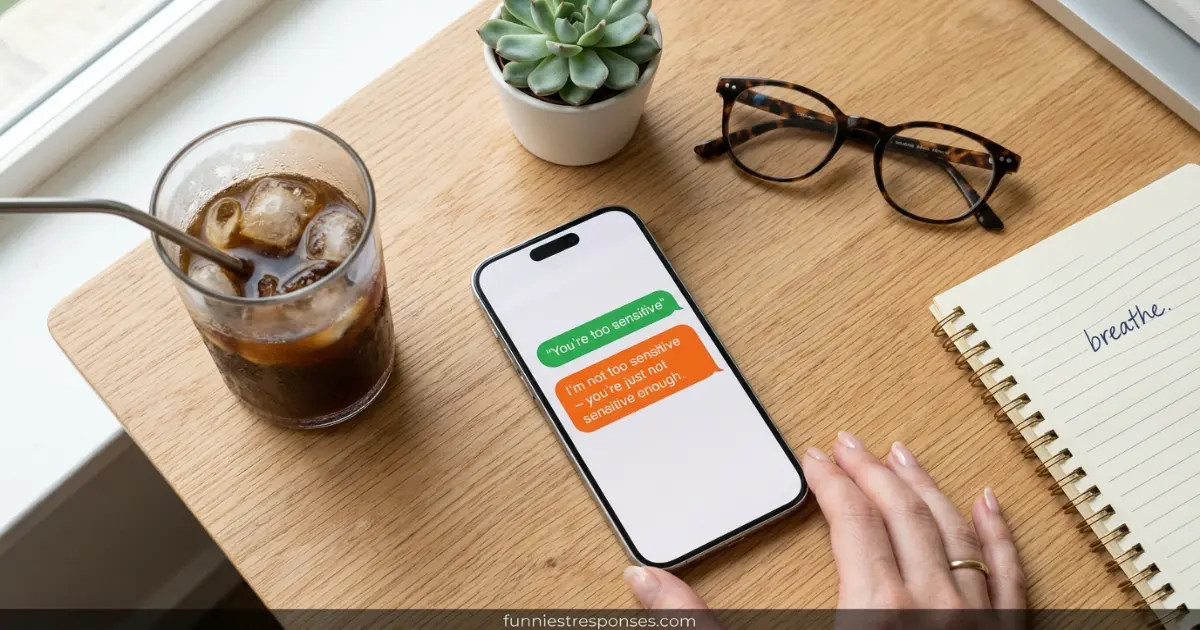
Texting vs. In-Person: What Changes
Over text, the “you’re too sensitive” dismissal lacks tone entirely. That can make it feel even colder. Your reply needs to be clear but light. Use an emoji like 🙃 or 😌 to signal you’re not furious. Keep it shorter than in-person. Examples:
- “I’m not too sensitive. You’re just too comfortable being rude 🤷”
- “Let’s call it ‘accurately reactive’ and move on.”
- “Noted. Anyway, back to the original point…”
One advantage of texting: you can take 5 minutes to cool down before replying. Use that gift. Never fire back immediately when you’re hot.
If they keep saying “you’re too sensitive” after your first comeback, just repeat the same line verbatim. “I heard you. I still feel what I feel.” Then change the subject. Repetition without escalation is the ultimate power move — they’ll get bored before you do.
What NOT to Say (Mistakes That Backfire)
Avoid these at all costs. They either prove their point or make the situation worse:
- ❌ “No I’m NOT!” — Aggressive denial makes you look exactly “too sensitive.”
- ❌ “Well you’re too insensitive!” — Mirroring insults just starts a fight.
- ❌ Crying or walking away dramatically. — Gives them exactly what they wanted: proof you’re “overreacting.”
- ❌ Explaining your entire childhood trauma to justify your reaction. — Too much information. Stay in the present moment.
Also, never use these comebacks on someone who is genuinely apologizing. If they say “I’m sorry, I know you’re sensitive about that,” that’s different. Respond with “Thank you for apologizing.”
Real-World Scenarios (From Fights to Family Dinners)
Argument with a partner:
Partner: “God, you’re so sensitive. I was just joking.”
You (calm, small smile): “Great. Jokes are supposed to be funny for everyone. That one wasn’t.”
Result: They pause, maybe even apologize.
Workplace (boss says it):
Boss: “You’re being too sensitive about the feedback.”
You: “I appreciate the feedback. And I’d appreciate if we kept it to the work itself, not my emotional response.”
Result: You look professional and controlled.
Family dinner (uncle who always teases):
Uncle: “Oh, don’t be so sensitive. It’s just a joke.”
You: “I’m not hurt, Uncle Dave. I’m just letting you know it didn’t land. Anyway, pass the potatoes?”
Result: You set a boundary without drama.

When NOT to Use These (Serious Exception)
Humor is a tool, not always the answer. If someone says “you’re too sensitive” in a context where they are genuinely concerned about you (e.g., “You cry at every commercial — are you okay?”), don’t fire a comeback. Say “I’m just having a rough week, thanks for checking.” Also, if the person is in a position of power over you (a judge, a police officer, a professor during a grading dispute), stay formal: “I understand your perspective. I’ll reflect on that.” Finally, if you’re in a therapy session or a support group, just be honest. Wit has its place; vulnerability does too.
Related Reading on FunniestResponses
FAQs: Your Burning Comeback Questions
What if the person gets offended by my witty comeback?
Then they’re being too sensitive. (Kidding.) Apologize lightly: “Sorry, I was trying to lighten the mood. Let’s just drop it.” Then move on. If they keep pushing, disengage: “I think we’re talking in circles. Let’s take a break.”
Can I use these on a narcissist or bully?
Yes, but be careful. Narcissists may escalate. The best reply for a bully is often the gentle shutdown (“Noted. Anyway…”). Keep it boring. Don’t try to “win” – just deflect and exit the conversation.
What’s the best response for a friend who says it casually?
Playful reframes work great: “And you’re too comfortable being blunt. We all have our things.” Say it with a smile. Real friends will laugh and maybe even apologize.
How do I reply over text without sounding angry?
Add an emoji like 🙃 or 😌. Example: “I’m not too sensitive – I just notice things 🙃” The emoji signals lightness. Avoid exclamation points or all caps.
Is it ever okay to just say nothing?
Absolutely. Silence is a powerful reply. Stare at them for 3 seconds, shrug, and walk away. That often communicates more than words. Use silence when you’re too angry to speak calmly.
What if they say “you’re too sensitive” about a real trauma?
Then it’s not a joke. Say firmly: “This isn’t about sensitivity. This is about something that hurt me. I need you to hear that.” No humor needed. Protect your boundaries.
How do I practice these so they sound natural?
Role-play with a trusted friend. Or say them aloud to your pet or mirror. Record yourself. The goal is to sound calm and slightly amused — not rehearsed. After 5 practice runs, you’ll own it.
📋 Your Cheat Sheet — Top 3 Comebacks to Memorize:
- “I’m not too sensitive. You’re just not sensitive enough.” – flips the script perfectly.
- “I’m reacting appropriately to what you said. Let’s stay on topic.” – calm and unshakeable.
- “Okay. Noted. Anyway…” – the graceful exit that ends the argument.
Bonus line for close friends: “I prefer ‘emotionally gifted.’ But sure.”